
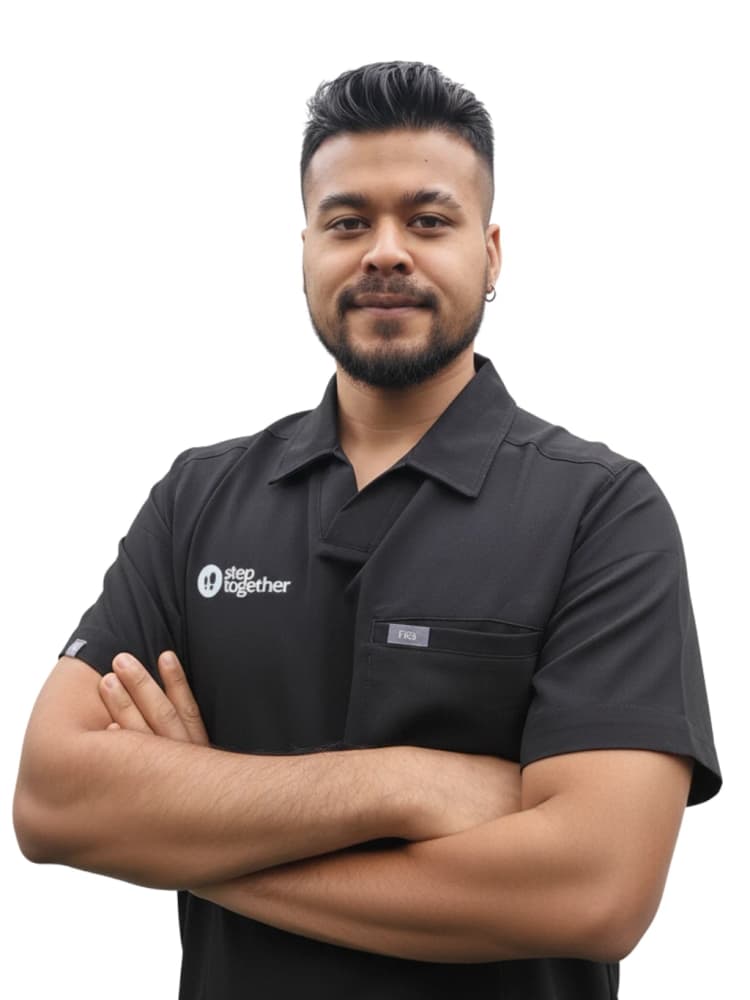
I grew to be about 225 lbs as a shorter kid between the ages of 10 and 15.
My mid-teens were when I decided to take matters into my own hands and do something about my weight. I started working out at home, borrowed books from the library on fitness, and started going to the gym, all while living on canned tuna, eggs, cucumbers, gummy worms, Pop-Tarts, and whatever food my mother cooked.
It was clear to me that my parents did not care enough about their own habits and weight to do something real about their health, or mine, beyond talking about what they were going to do and then not doing it, or managing and shaming me for my eating habits. Over many years, those habits became wrapped in secrecy, sneaking around, shame, and guilt.
I would steal money and break into the flimsy locked kitchen pantries. I would use that money to buy candy, chips, snacks, and pop from the local corner store. I thought I was being sly, hiding the bags from my parents, eating them whenever they weren't home, and throwing the wrappers into neighborhood trash bins instead of the ones at home.
All I would hear when I ate treats or large amounts of food, really whatever I saw that I liked the taste of, at the most random times of the day and night, was "don't do this" or "if you keep doing this, we'll take it away or hide it from you."
There was zero curiosity, and no genuine attentiveness without an agenda.
Just judgment, management, withholding, and punishment.
As a child, I felt alone, isolated, misunderstood, ashamed, and lonely, like an outcast. That happened both at school, where I was picked on for my weight, looks, smarts, or something else, and at home, where I never felt like my parents truly tried to understand me.
I believe the real root cause of excess weight in my childhood had three parts.
One, a lack of sound education, firm guidance, and emotional attunement from my emotionally absent and passive father, and from the other males around me. I didn't learn how to be confident and direct in my own life or trust my own decisions, because I did not see or learn that from him, and I also did not respect the other males in his life as a kid. They were all overweight or unhealthy in other ways, and I didn't see them modeling physical, emotional, or relational well-being.
Two, an emotionally reactive mother who would criticize and manage me quite often.
Both parents were emotionally absent, neglectful, and not very present, even if they were doing their best.
And three, a lack of education, modeling, genuine care, and guidance that my parents never got themselves. You can't be what you can't see, and you can't influence what you can't reach.
Under all of that, I also see a generation of adults, and a system of education, that focused more on information over embodiment.
Knowing things and being educated was seen as more valuable than actually practicing what you preached and acting on the knowledge you had. It's one thing to mentally know what health is. It's another thing to act on that knowing so that you have a directly felt experience of being healthy.
My parents didn't know much about nutrition, food quality, or quantity, and how deeply those things affect someone's health, beyond what they learned from their own parents about how to survive. So anything I learned from them about food was directly related to survival stress, not how to eat in order to live fully and thrive, free of stress.
In terms of emotional challenges, stress, and family dynamics that influenced my eating habits, my family didn't eat together very often. So I would end up eating alone, left to my own devices. And when we did eat together, there was usually arguing, or just casual conversation that I didn't feel engaged in, so I stayed quiet and focused on my food, sometimes being picky, sometimes eating whatever was in front of me, and more.
My school lunches were always some kind of white bread, and despite my mom's attempts to feed me foods like carrots and cucumbers, I would trade them at school for gummies, Pop-Tarts, and cookies, because on some level beneath that behavior, that is what I associated with feeling accepted and valued.
There were also many times when my family got together with other families for potlucks, where overeating, eating until you were stuffed late into the night, and eating huge amounts of treats and sweets was encouraged so that the kids would have energy, play together, and leave the adults alone. Looking back now as an adult, I can see that it may have come from good intentions, but it also came from a deeply irresponsible place.
Those habits became ingrained in me. I didn't know any better, and it took me years to truly see and understand how deeply they affected my mental, emotional, and physical health, and how those learned habits held me back from my full potential as an adult.
Unhealthy food habits later turned into substance addiction, self-destructive behavior, and destructive behavior toward others in my late teens and early 20s. While I was also using hard drugs and alcohol, I continued to have an unhealthy relationship with food, where I would either eat large amounts, or healthy foods and then starve myself or fast, using the quality of food or the amount of exercise I did to justify the way I treated myself.
I tried a lot of diets and many ways of trying to lose fat: keto, carnivore, paleo, vegetarian, intermittent fasting, and different exercise regimens. And while I learned something valuable each time, I always came back to a place where I did not like myself or feel confident. I believed dieting, not eating, or just exercising a lot was the solution.
I was so mistaken.
It took finally looking in the mirror, being held by people who truly cared about me, seeing how much I actually hated myself, and feeling how miserable I was in my life, despite outwardly looking like I had it together, to become radically honest about my habits and how they were affecting my life, relationships, health, and work.
It took me years to unlearn that behavior of unconsciously internalized self-aggrandizement, violence, and lack of care toward myself, and to begin eating in a way that actually nourished me and made me feel better from the inside out, rather than fueling constant self-dislike and pain.
Why I Joined Step Together
"Take care of the children, and everything will work out."
I don't think this is just about our kids. I think it is also about the inner children we each carry inside us, the kids we used to be, who felt neglected, abandoned, unloved, unsupported, and uncared for, and around whom we built entire identities and lives just to stay safe.
The problem is that eventually, that way of living reaches its breaking point. What kept you safe and got you here is not what will bring you where you want to go.
A life that requires being led by an adult is often still being led by a hurting inner kid who believed they had to do it all alone.
I strongly believe in the importance of whole and healthy families with powerful leadership skills. Truly strong and healthy men and women who come together to create something when they know themselves deeply and well. People are what change and affect the world. Grown people start as children. You do not have to be an adult to start creating positive change, but the sooner it starts, the better.
Children come from families. The more complete, whole, educated, loving, and understanding a family is, the healthier a child becomes. The healthier and more secure a child is, the more powerful and connected to themselves they are. And the more connected they are to themselves, the more positive impact they will have on the world they live in.
Coming from a home that felt broken, from a family love that felt incomplete and like it was missing something, and going through my own struggles with weight, food, relationships, substance addiction, and homelessness, I can say that the two biggest things that helped me change the direction of my life were:
One, people who stepped into my life, told me the truth even when I did not like it, and helped me when I really needed help.
And two, acting on my own deepest desire and willingness to change, and to create a better quality of life.
Knowing what I know now, I honestly think it would be closed off and wrong of me not to help people and give back, whether I were paid for it or not. But that is not why I do it.
Helping children and families matters to me because I know what it is like to live life in pain, even if that pain is not admitted. I know where that pain comes from, and I know how deeply it affects you and the people you care about. I strongly believe that life is better for you and those around you when you are no longer living that way.
If I can reach one parent, one child, and their lives improve because of what they choose to do, I'm happy. But I want a million kids and a million families to be positively affected, and more.
The biggest thing that attracted me to Step Together was that the philosophy centers around self-responsibility and impact, two things I believe, when truly understood through identity and behavior change, can change someone's life for the better.
What makes this program different from others that just tell you what to do, give you a couple of resources, and step back until your next appointment, is that I, just like all the other coaches, have been where your kids are, and we can relate.
We are coming back for them, armed with the tools and knowledge we wish we had at that age, so that they can live better lives and do much cooler things than you and I.
The truth is, you're in the way. So we have to start with you first.
We are not stepping back. We step with you, because we have been down that path and up that rocky mountain. We know how hard it is to do it alone.
That is why it's called Step Together.
How I'm Uniquely Positioned to Help
My life experience with weight management, exercise, and learning what it takes to truly change deeply rooted habits and seemingly fixed identities is a big part of what equips me to do this work.
My path led me into several certifications, trainings, and areas of experience in physical training, yoga, men's coaching, clinical and therapeutic breathwork, bodywork, parts work, male youth mentorship, and male rites of passage.
I am particularly passionate about helping families and people navigate relational conflict, addiction, and life-stage transitions through physical and personal development, and through understanding how their energy works.
These are often the loneliest parts of a person's life, and when we are left to our own devices to figure it out, I have found, both in my own life and in working with others, that it often leads to feeling even more lost, lonely, and confused, even if we are putting on a face that things are okay, and even if we say we do not care.
The truth is, we really do care.
People need connection and community in order to feel complete and whole in their life and personal growth. Without that, things tend to fall apart if they were not stable or secure to begin with.
And I think that when things do fall apart, sometimes it is only so that the right things can be built in their place.
I care about helping people build something real, and build it from the ground up.
What I Want Every Parent to Hear
You can't be what you can't see, and you can't influence what you can't reach.
Who you are being was modeled to you, both consciously and unconsciously. The things your child is doing, they learned somewhere in their environment and awareness, whether directly or indirectly through your behavior, or through the people and things around them.
I don't think you can truly help your child build a healthy relationship with food, with themselves, and with the people around them, if you do not first do that work in yourself and exemplify it.
So be the change you want to see in your kid.
And if you want to reach into them and truly touch their heart, mind, and soul, reach into yourself first and find the kid, the heart, and the soul in you.
Most of how parenting is taught is backwards, and based on an incomplete understanding of human behavior, and on what parents learned from parents who did not know as much as we know today.
You don't orient and regulate your child and their needs. You understand your needs and regulate yourself, and your child will orient and regulate you.
You are the parent. The guardian. The caretaker. The leader.
Lead yourself first. Your kid will follow.
Take responsibility for yourself, and for the life you have created and are living, and teach your child how to do the same.
That is how things truly change.