


Step Together

Find the Real Reason Your Child Keeps Gaining Weight, and Turn It Around

Most experts miss the root cause: impulsivity (ADHD), emotional eating, and more. Find yours with a 20-min diagnostic. Then get a clear action plan and a private 1:1 session with a Nutritional Therapist to understand your immediate next step.

PHASE 1 · MAYA’S EATING PROFILEThe Impulse EaterThe urge wins before the thinking part of the brain kicks in.PHASE 2 · WHERE YOUR 7 PILLARS STANDStep UpFOCUS FIRST31Step WellFOCUS FIRST35Step ForwardFOCUS FIRST50Step Inward56Step Into Their Shoes58Step In SyncSTRONGEST69Step CloserSTRONGEST89YOUR NEXT STEPINCLUDEDYour 1:1 Reviewwith a NutritionalTherapistPick a time that works for youMON2TUE3WED4THU5FRI6PHASE 2 · YOUR PATHMaya’s pathforwardTODAYWhere Maya is today1YOU BUILDThe skills you build2YOU PUT IN PLACEThe structure at home3MAYA LEARNSWhat Maya learnsWHERE IT LEADSAll 7 drivers workingfor Maya
500+ families we’ve helped solve their child’s root cause
Holiday special
The Family Footprint
Your root cause diagnostic + a 1:1 Nutritional Therapy session
$199$27
You save $172 this holiday season
  1. 1Your details
  2. 2Payment
  • 30-day money-back promise
  • Start right away

Life-Changing Results in Under 4 Months

And it all starts with the Family Footprint.

  • A 9-year-old girl, before and after
    “Our daughter started questioning things instead of automatically going back for more food. She started asking, ‘Do I need this?’”
    Holly, mom of a 9-year-old girl
  • An 11-year-old boy, before and after
    “Now he’s happier, more balanced, and he doesn’t have to hide food anymore. He even tells us he’s lost weight without us ever asking about it.”
    Amelia, mom of an 11-year-old boy
  • George, 16, before and after
    “George has become more mindful of what he puts in his mouth, perhaps for the first time in his adolescent life.”
    Jess, mom of 16-year-old George

If You’re Like the Parents We’ve Helped, You’ve Exhausted the Conventional Methods

Cutting out sugarMore exercise and sportsThe pediatricianA therapistMeal plans and dietsA dietitian

And nothing you try is working. At home, it still looks like this.

What 1,060 parents told us about their child when they came to us
  • 75%“I’m still hungry” after dinner; never seems satisfied
  • 73%Sneaks or hides food
  • 71%Wanders into the kitchen over and over
  • 66%Eats fast and asks for seconds and thirds
  • 64%A meltdown or big upset when you say no
What parents told us about themselves
  • 95%Worry about what their child eats when they’re not around
  • 86%Fear their child will grow into an adult who struggles with weight, confidence and self-worth
  • 76%Say the guilt is the worst feeling in the world
  • 73%Worry the weight is making it harder to make friends, feel confident and be truly happy

The worst part isn’t the money, or the hours in waiting rooms and on wait lists.

  • It’s the argument at the dinner table, again.
  • It’s the shame on their face when you say “you’ve had enough.”
  • It’s the birthday party or pool party they didn’t want to go to.
  • It’s the checkup that ended with “pre‑diabetes.”

And it’s the guilt.

It’s Not Your Fault It’s Not Working. The Whole System Is Trained for the Wrong Thing.

It’s not the experts’ fault either. Each one was trained to treat one part of your child. None of them was trained to find the root cause.

The pediatrician

Fifteen minutes, a growth chart, and “eat less, move more.” Your child leaves the room feeling ashamed, and nothing at home changes.

Sees: The growth chart Misses: Why your child eats
Dr. Dan
A pediatrician, in his own words
“In a pediatric office we have 15 minutes of time, and to go into the reasons why and how to plan, it’s impossible. We just don’t have that ability.”

“Addressing that from the parents’ aspect… which is what Step Together seems to do very well, is really, really vital.”


Dr. Dan, Pediatrician, trusted by 1M+ parents. From our YouTube interview
The dietitian

A meal plan that works for two weeks. Then the snacks go missing from the pantry again, and the plan quietly goes in a drawer.

Sees: What’s on the plate Misses: The urge that wins
Michael, beforeBefore
Michael, afterAfter
Even dietitians come to us
Michael is a registered dietitian. He still couldn’t help his 14-year-old son.

Nothing in his training covered what was underneath. With our approach his son turned things around, and so did Michael: his own undiagnosed ADHD had been part of his weight story all along.

The therapist

Weekly sessions with your child alone. Helpful for feelings, but it doesn’t give you the tools to handle those feelings at home, or the daily challenges around food.

Sees: The feelings Misses: Tools for you at home

Each one sees one piece. None of them sees your family, and none of them helps your home change.

What they all miss is the root cause. It’s why doctors, dietitians and therapists often come to us for their own families.

So what is the root cause?

What we found in 500+ families we’ve helped

Weight Is the Symptom

We went back through every family we’ve helped, looking for what the ones who turned it around had in common. It was the same every time: the weight was a symptom. Something underneath was driving it.

On the surface, everyone looks at the weight, the diet and the exercise. Almost nobody looks at what’s happening underneath.

WeightTHE SYMPTOMWhat everyonetreats: diets,meal plans,exerciseTHE ROOT CAUSEWhat’s really driving itBig feelings they can’t settle yetAn ADHD brain, diagnosed or notHow the adults at home model health…a different mix in every familyABOVE THE WATERBELOW THE WATER
What everyone treats is only the tip. What drives it sits under the water.
timehow big it feelsTypical brainSensitive, ADHD brainFood: the fastest way down
The same big feeling: it arrives faster, goes higher and stays longer
Big feelings

For a sensitive child, a feeling arrives faster, goes higher and stays longer. Food becomes the fastest way they’ve found to feel okay.

What parents told us: 6 in 10 said food and screens are the two things that calm their child down.
Other kids1xKids with ADHDup to 12x
How likely kids are to lose control around food (Johns Hopkins study)
An ADHD brain, diagnosed or not

Kids with ADHD traits are up to 12x more likely to lose control around food. Their brain needs more stimulation than the school day gives it, and it learns quickly that food delivers the dopamine it’s craving. Soon they just feel hungry all the time.

What parents told us: 77% said their child can’t stand being bored. 64% said they act before thinking.
At homeYour childGrandparentsSchool
The adults around your child: at home first, then grandparents and school
The adults around your child

When the grown-ups handle food differently, or have their own history with weight, or difficulty regulating their own emotions, a child’s impulses have nothing to lean on.

What parents told us: 59% said they still struggle with their own weight or eating. 1 in 4 disagree with their partner about snacks.

Find the root cause, and the weight follows.

The Family Footprint is the fastest way to find it.$199$27In 20 minutes, you’ll know what’s driving your child’s eating and what to do first.
  • 30-day money-back promise
  • Start right away

Three Families. Three Different Root Causes.

Every one of them had tried the usual help for years. Here’s what everyone saw, what was really going on, and what changed.

The Emotional Eater

The sensitive one. Eats to soothe when they feel anxious, stressed or uncomfortable.

A quiet, observant 9-year-old girl, before and after
A quiet, observant 9-year-old girl
What everyone saw
Her parents tried a therapist and a nutritionist. The more sessions she had, the heavier and more self-conscious she got.
The root cause
Every appointment where adults talked about her body told her something was wrong with her. The shame drove more eating.
What changed
We only worked with her parents. She never knew. She felt loved instead of watched, and the weight came off without anyone talking about it.
The Impulsive Eater

Always “hungry,” eats fast, goes back for seconds and thirds, can’t walk past food.

George, 16, one of four siblings, before and after
George, 16, one of four siblings
What everyone saw
His mom wrote research papers on childhood weight. What she did worked for every child in the house but George.
The root cause
George has ADHD, so his brain can’t say no to an impulse yet. And his parents had four kids with four different needs to handle in one home.
What changed
They learned how to set up the home for his ADHD in a way that still works for his three siblings. Things turned around in weeks, after years.
Both

Impulses and feelings both drive the eating. The most common profile, and the one most plans miss.

An 11-year-old boy, before and after
An 11-year-old boy
What everyone saw
Every time his parents took away screens and sweets, he started eating raw pasta. Nobody could figure out why.
The root cause
A brain seeking stimulation to feel okay. Take away the two things that helped, and it finds another way.
What changed
His parents learned to help him handle the urge itself. The weight started to come off without anyone focusing on it.
What most parents are told

“They’ll Grow Out of It”

Most pediatricians tell parents to wait, and hope their child will grow out of it. This is what we’ve seen in the families who waited.

Your relationship takes the hit

You become the food police. Every “you’ve had enough” pushes your child a little further away. First they hide the eating, then they start hiding from you.

The pattern gets stronger

A habit practiced for one more year is one year harder to change. It will never be easier to turn around than it is today.

Their confidence goes first

They sit out the party, the team, the pool. A child who stops joining in starts to believe that’s just who they are.

The doctor’s numbers start to move

For some families the wake-up call is a checkup that ends with “pre‑diabetes” or “high blood sugar.”

It’s the fear almost every parent tells us about: that their child grows into an adult who still struggles.

The confidence your child gains is worth more than anything you could save by waiting.

Done waiting for them to grow out of it?$199$27The Family Footprint shows you what’s driving it and what to do first, in 20 minutes.
  • 30-day money-back promise
  • Start right away
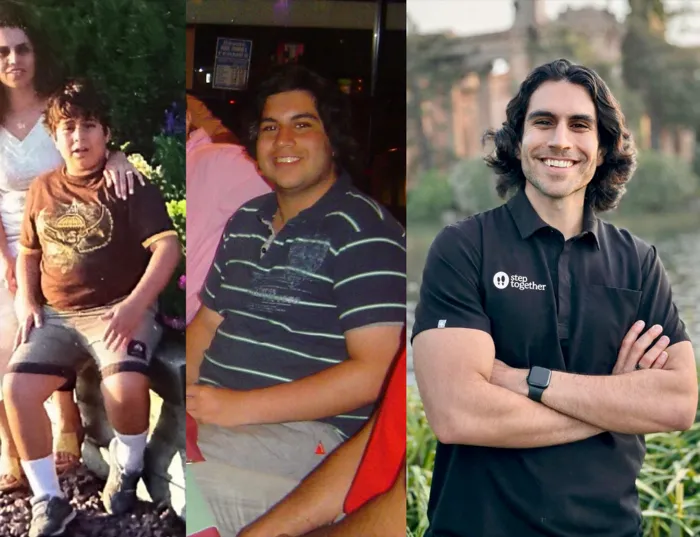
Kamy at seven, at fifteen, and today
Age 7Age 15Today
Why I built Step Together

I was the kid who couldn’t stop eating.

Both of my parents are doctors, and they tried everything. My mom paid what would be about $30,000 today for all the support and big-name weight loss programs. I would lose weight during the summer, and by the next year it was all back.

When she was at her wit’s end, she locked away the snacks and took away my video games. She had no idea she was taking away the only two things helping me feel okay. I was so restless I chewed on my wooden bed frame. The scratches are still there.

Even with two doctors in the house, nobody ever asked why I was eating. It took me years to find the answer. So we built a diagnostic that asks why. It takes about 20 minutes, and it shows you what took me decades to understand.

Kamy MoussaviNutritional Therapist and Founder of Step Together
“You helped him more in 16 weeks than I have in 16 years.”
A mom who wrote research papers on children’s weight
I have a health degree and researched childhood obesity, but I still felt stumped helping George because the emotional piece tied to food was the part I couldn’t change on my own.
Jess & GeorgeMother and 16-year-old son
So we made it simple

One 20-Minute Diagnostic That Looks at Your Whole Family

You take it. Your child doesn’t. We only work with parents, so your child never sits in another appointment about their body, and never feels watched or ashamed.

We took everything we learned from those 500+ families and turned it into one in-depth diagnostic: the Family Footprint. It asks about the 7 areas of family life that decided who turned things around.

Step Well
The healthy home

The house does the work, so you can stop policing every snack.

Step In Sync
The adults around your child

Every adult gives the same answer, so your child stops shopping for a yes.

Step Up
Leading with warmth and structure

You hold a no calmly, and the meltdowns get shorter.

Step Inward
Your own story

You stay calm when it gets hard, and your child borrows that calm.

Step Into Their Shoes
Your child's inner world

You see what the eating is really about, before you answer the food.

Step Closer
Connection with your child

Your child comes to you with the truth, so nothing has to be hidden.

Step Forward
Change that lasts

Small steps that stick, so one hard day never means starting over.

Here’s everything you get.

Your Child’s Eating Profile

Emotional, impulsive, or both, and which one leads. The first clue to what’s really driving your child’s eating.

IncludedValue: $49
The Full Family Footprint Diagnostic

The same 20-minute assessment we use with every family in our program, across the 7 areas of family life we’ve seen matter in 500+ families.

IncludedValue: $129
Your Root-Cause Report

What’s driving your child’s eating and weight, in plain words, and why the things you’ve tried haven’t worked.

IncludedValue: $97
Your Roadmap and Action Plan

Which area to start with for your family, what to do first, and what comes next. The same plan we’d start with if you worked with us 1:1.

IncludedValue: $97
A 1:1 Review With a Nutritional Therapist

A video call with someone on our team who has personally helped families like yours. They tell you exactly what’s missing and how to get started right away. Parents tell us this one call was worth more than ten years with their pediatrician.

IncludedValue: $179
The Partner Footprint

Your partner or co-parent takes it too, so you both see the same picture. Most families find their biggest gap where the two of you see things differently.

IncludedValue: $99
Total value$650
Usually$199
Today$27
The holiday special: a gift to your family
  • 30-day money-back promise
  • Start right away
How it works

Three Steps. No Referral. No Waiting List.

Step 01 20 Minutes
Take the Family Footprint

Answer simple questions about your child, your home and yourself, on your phone, whenever it suits you. Your progress saves as you go.

Your child takes no part
Step 02 Right Away
Read your report

Your child’s Eating Profile, what’s driving it, where each area of family life stands, and your roadmap in the right order.

Share it with your partner
Step 03 Pick a Time
Review it 1:1 with a Nutritional Therapist

Book a time you and your partner can both join. A Nutritional Therapist walks you through it, answers your questions, and gives you your first step.

Included in your order

Once you know what’s really driving it, you get to choose…

Do it on your own

Take your report and action plan, and start with the first change this week. Many families do.

Get more support

If you’d like help, your Nutritional Therapist can tell you about our programs. Whether you add that is up to you.

Either way, the guessing is over.

Who Reviews It With You

Every one of us was a kid who struggled with weight, and we’ve personally helped families like yours. We’ve been where your child is. Tap anyone to read their story.

“We started creating a culture of ‘why.’”
A more active son, and a family speaking the same language
The biggest change was our family’s relationship with food. Once I started understanding what I was feeling instead of reaching for food, those habits started to go away with the kids too. We were all speaking the same language and working through it together.
Beverly & ChrisParents of an 11-year-old son

What Changes at Home

  1. You finally know what’s really driving it

    Feelings, impulse, what happens at home, or a mix. Once you know which, the advice you’ve heard for years starts to make sense, and you can stop trying everything at once.

  2. You stop being the food police

    Instead of more rules, you change the one or two things at home that keep the pattern going. Most parents tell us the arguments at the table are the first thing to go.

  3. Your child never sits in another appointment about their body

    You take the diagnostic, about your child and your family. Most of the kids on this page had no idea their parents were doing anything at all.

  4. Your child starts to change, without being told to

    In the families who go on to work with us, parents tell us the same things: their child stops hiding food, starts asking “Do I need this?”, and one day brings up their own progress before anyone asks.

Every family on this page started the same way: by understanding the real root cause first.

“Step Together orchestrated an awakening in me and in our family.”
People at school and around town noticed the change
After the summer, people at school and around town started noticing the change in Jackson. At the football game, someone asked, “Did Jackson lose like 20 pounds? He looks great.” That was the moment we could see how much had shifted for him.
Schwa & KatrinaParents of a 12-year-old son and a 6-year-old daughter
The holiday special

Start Today. $650 of Value for $27.

We’re running this for the holidays, because we want every family to take a healthy first step into the new year.

The Family Footprint
Find what’s really driving your child’s weight, in about 20 minutes
Total value$650Usually$199Today$27
Our 30-day promise

Take the Footprint, read your report, have your Review. If it doesn’t help you see your child more clearly, email us within 30 days and we’ll refund every cent. Keep the report.

Is This for Your Family?

We only work with parents, and we do our best work with a certain kind of family. Here’s how to tell if it’s yours.

It’s for you if…
  • Your child is impulsive, very sensitive, or can’t stand being bored, with or without an ADHD diagnosis
  • You’ve tried the doctor, a dietitian or a therapist, the diets and the sports, and you’re still worried
  • You want to help without your child ever feeling watched, blamed or ashamed
  • You’re ready to look at what happens at home, not only at your child
It’s not for you if…
  • You want a meal plan or a calorie target
  • You’re looking for a quick diet before an event
  • You want medication or a supplement to fix it
  • You want someone to talk to your child about their weight
  • You want your child to change while everything at home stays the same

Still not sure? Take it and see. If it isn’t right for your family, email us within 30 days and we’ll refund every cent.

“Now he doesn’t have to hide food anymore.”
No more sneaking food and eating in rooms
Before this, we were battling screen time, snacking, sneaking food, and eating in rooms. Step Together helped us understand the reasons behind the habits, instead of just cracking down and enforcing rules.
Amelia & DarenParents of an 11-year-old son

Do the Changes Last? Hear It From Parents

Holly C.
We're 6 months in. At Christmas, my 8 year old, who still struggles to walk away from 2nd and 3rd helpings, said she was full halfway through her first plate and asked to be excused! She's listening to her body signals!

Posted in our parent community

Richard
It is a wonderful, eye-opening experience! I learned not to react, but instead to model behaviors, and our family dynamic has gotten much better in the process. The changes are amazing if you stick with it!

Posted in our parent community

Melanie Anne Pierce
We are on week 14 right now and this program has been a Godsend. Not a quick fix, but we're on the right trajectory now.

Comment on Facebook

“My son turned down a popsicle at football practice.”
More confident kids, more willing to try new foods
At first, I thought the kids just needed to do what I told them to do because I’m the parent. But I started realizing that my behavior, what I was eating, my activity level, all of it was impacting their success.
Jason & MelissaParents of a 12-year-old son and a 9-year-old daughter
Got questions?

What Parents Ask Us Most

My child has already seen a pediatrician, a dietitian and a therapist. Why would this be different?

Each of them looked at one piece: the body, the food, or the feelings. The Footprint looks at the whole family around your child, because that’s where the patterns that keep the eating going live. Most parents who take it see, for the first time, why the earlier help didn’t stick.

Is this a diet?

No. No meal plans, no counting and no weigh-ins. The Footprint is about why your child eats when they aren’t hungry, and what at home keeps that going.

Does this involve medication?

No. No weight-loss medication, no appetite medication, and no prescriptions of any kind. The Footprint finds what’s driving the eating, and your action plan is about what changes at home: skills, structure, and how your family handles food and feelings.

Does my child need an ADHD diagnosis?

No. Many of the kids we work with have no diagnosis. The Footprint looks at impulse and big feelings around food, whatever the label, and tells you how much each one plays a part for your child.

Does my child have to take it?

No. You take it, about your child and your family. Nothing is asked of your child, and nothing about it needs to feel like a test to them.

What happens in the 1:1 Review?

You book a video call with one of our Nutritional Therapists, at a time you and your partner can both join. They go through your report with you, answer your questions, and help you decide on your first step. If you’d like more support, they can tell you about our programs. Whether you add that is up to you.

Should my partner take it too?

Yes, if you can. The Partner Footprint is included, and kids change fastest when both parents see the same picture.

My partner doesn’t think it’s a problem. What then?

That’s more common than you’d think. It’s rarely that your partner doesn’t care. Usually the two of you just don’t see the problem the same way yet. That’s what the Partner Footprint is for: your partner answers from their own point of view, and we bring the two together, so you can both see where you agree and where you don’t. And if they’re not on board yet, you can take the Footprint on your own and start helping your child yourself.

Why is it only $27?

It’s usually $199. For the holidays we lowered it, because we want every family to be able to take a healthy first step into the new year, and because we’d rather you see what’s really going on than keep guessing.

What if it doesn’t help us?

Email us within 30 days and we’ll refund every cent. Keep the report.

You’ve read this far for a reason

Maybe it was the discouraging advice from your pediatrician. Maybe it was the wrappers behind the bed. Maybe it was the birthday party they didn’t want to go to, or the checkup that ended with “pre‑diabetes.”

This holiday season a lot of families will sit down to a table full of food with a child who can’t stop eating, and a parent quietly watching every plate. We know that table. Most of us grew up at it.

You don’t have to keep guessing. Twenty minutes, a report written for your family, and a Nutritional Therapist to walk you through it.

Kamy and the Step Together team
The Family Footprint is the fastest way to start turning this around.$199$27In 20 minutes, you’ll know what’s driving your child’s eating and what to do first.
  • 30-day money-back promise
  • Start right away

The Family Footprint is an educational assessment for parents. It is not a medical diagnosis and does not replace care from your child’s doctor. Results vary from family to family.

This site is not part of the Facebook website or Meta Platforms, Inc., and is not endorsed by Facebook in any way.